

Artificial intelligence is changing how businesses handle customer conversations, lead generation, support and everyday operations. What started with rule-based chatbots has evolved into conversational AI that can understand context, retrieve business information and in some cases, interact with software and perform tasks.
That evolution has created an important business question: should you build an AI chatbot or an AI agent? The answer is not simply that one is newer or more powerful than the other.
- An AI chatbot can be the right solution for a business that needs fast, reliable customer assistance.
- An AI agent can be the better choice when the system needs to work toward a goal, use business tools and complete multiple steps.
For example, a digital agency in India may use an AI chatbot to answer questions about Shopify, Magento, CRM or custom software development. But if that same system needs to qualify a prospect, understand project requirements, check CRM record, create an opportunity and arrange a consultation, the workflow starts moving into AI-agent territory.
This guide explains the difference between AI agents and chatbots from both a business and technical perspective, so you can choose an architecture based on what you actually need to automate, not simply on the latest AI trend.
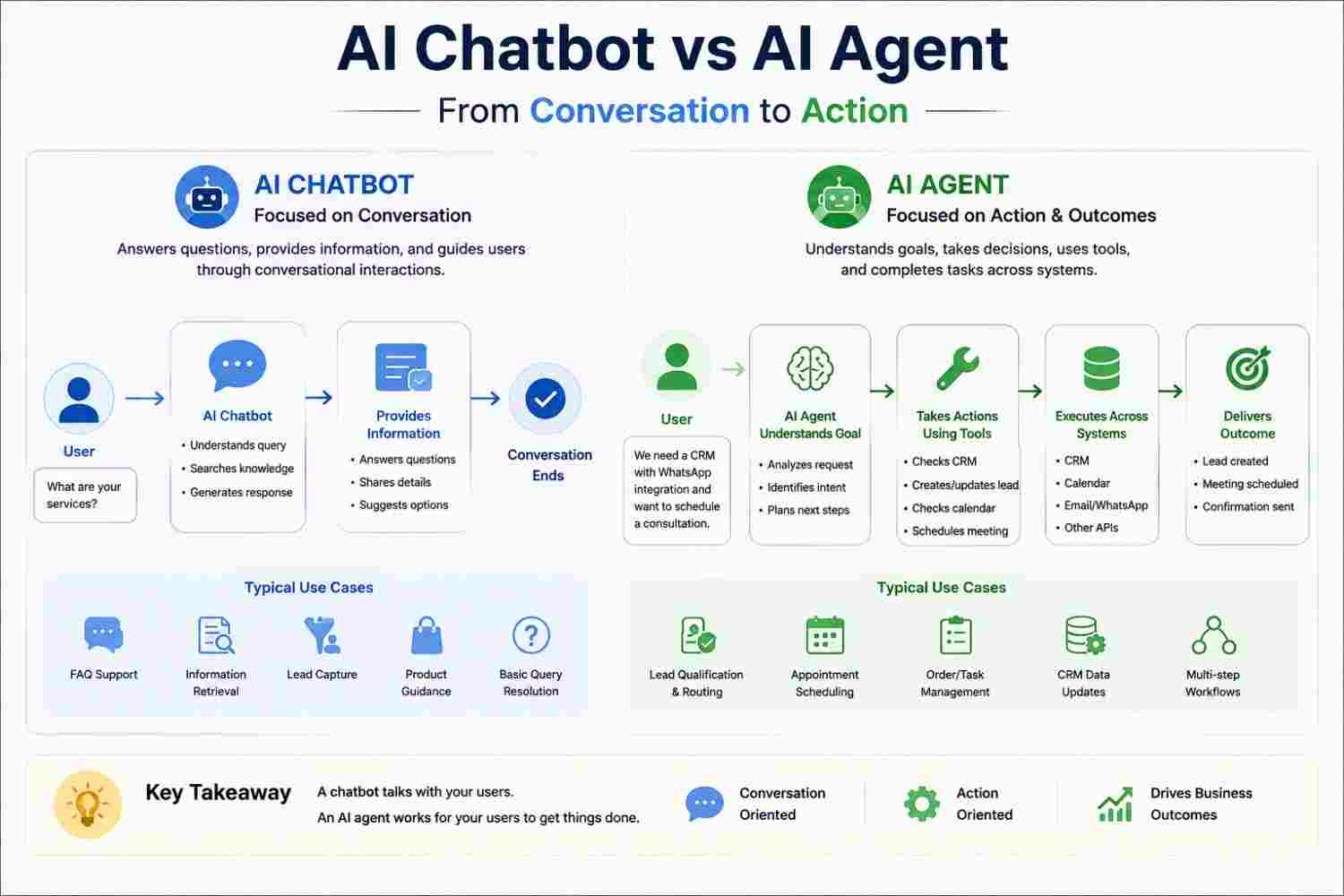
AI Agents vs AI Chatbots: What Is the Real Difference?
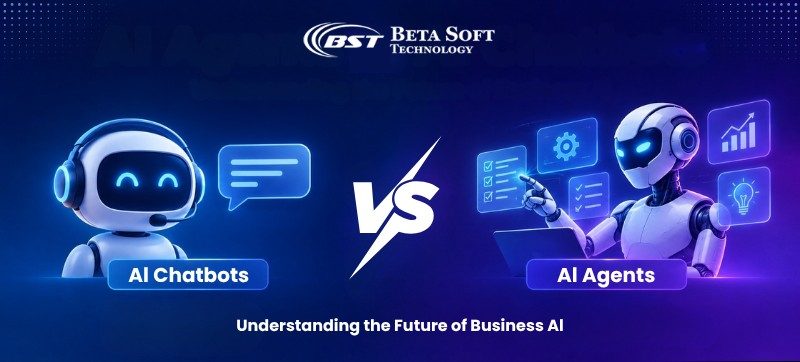
The simplest way to understand the difference is to look at the job each system is expected to perform. An AI chatbot is primarily a conversational interface. It receives a user’s message, understands the intent and provides an appropriate response or performs a limited predefined action.
An AI agent is more goal-oriented. Instead of only responding to the latest message, it can be designed to determine what needs to happen next, select approved tools, retrieve information, perform actions and continue through a workflow until the objective is completed or human intervention is required.
The distinction is not absolute. Modern AI chatbots can call APIs and perform actions, while some AI agents may be used through a chat interface. The more useful question is how much planning, orchestration, tool use and responsibility the system has.
What Is an AI Chatbot?
An AI chatbot is a software application that allows people to communicate with a business through natural language. Modern AI chatbot development often uses large language models, retrieval systems and business integrations so the chatbot can provide more relevant answers than older rule-based systems.
For a business website, an AI chatbot can explain services, answer common questions, capture enquiries and guide visitors to the right page or sales channel. A support chatbot can retrieve approved information about products, policies or troubleshooting steps. An internal chatbot can help employees find information in company documentation.
The important advantage is simplicity. When the business problem is mainly about communicating information or guiding a user through a predictable process, a chatbot can provide strong value without introducing unnecessary agentic complexity.
Common Business Uses for AI Chatbots
- Website customer support and FAQs
- Product or service information
- Lead capture and initial enquiry handling
- Internal knowledge assistance
- Order, delivery and policy questions
- Basic qualification and routing
- Guided customer conversations
What Is an AI Agent?
An AI agent is an AI-powered system designed to pursue a defined goal by using context, reasoning or decision logic, tools and business systems. Rather than stopping after generating a response, an agent can be designed to continue through a workflow.
Imagine a prospect tells a digital agency: “We need a Shopify store, CRM integration and an AI customer-support assistant.” A simple chatbot can explain those services and capture the lead. An AI agent could go further by structuring the requirements, asking qualification questions, checking whether the prospect already exists in the CRM, creating or updating an opportunity and initiating a consultation workflow.
That does not mean every agent should operate autonomously. Production AI agents need boundaries around permissions, data access, tool usage, validation and human approval. The engineering objective is controlled task execution, not unrestricted autonomy.
What Can AI Agents Do?
- Interpret a business goal or complex request
- Break a workflow into multiple steps
- Retrieve relevant business information
- Use approved APIs and software tools
- Update CRM or other business records
- Coordinate actions across multiple systems
- Escalate decisions that require human approval
AI Chatbot vs AI Agent: Key Technical Differences
| Capability | AI Chatbot | AI Agent |
| Natural-language conversation | Core capability | Core capability |
| Answering questions | Strong use case | Yes |
| Knowledge-base access | Common | Common |
| Lead capture | Common | Yes |
| CRM integration | Possible | Common for workflow agents |
| API/tool usage | Possible | Core capability |
| Multi-step workflows | Usually limited | Strong capability |
| Goal-oriented task execution | Limited | Core capability |
| Cross-system orchestration | Possible | Strong capability |
| Human escalation | Yes | Yes |
| Typical implementation complexity | Lower | Higher |
These are practical distinctions rather than strict industry definitions. A sophisticated chatbot can perform actions and an AI agent can answer a simple question. What changes is the system’s role and the complexity of the workflow it is responsible for.
When Should Your Business Choose an AI Chatbot?
Choose an AI chatbot when the primary business objective is to make information and assistance available through natural conversation. If customers repeatedly ask questions that can be answered from approved company information, a chatbot can reduce response time and give users immediate assistance.
For example, an eCommerce company could deploy a chatbot to answer questions about shipping, returns, product specifications and order policies. A digital agency could use one to explain its development services, collect project requirements and direct qualified enquiries to a sales consultant.
A chatbot is also a good choice when the business wants a controlled first phase of AI adoption. It can start with a limited knowledge base and a small number of integrations, then expand as the team learns from real conversations.
When Should Your Business Choose an AI Agent?
An AI agent becomes more appropriate when answering a question is only one step in the overall business process. If employees are manually interpreting requests, moving information between systems, creating tasks, updating records and coordinating follow-ups, there may be an opportunity for agentic automation.
For example, consider a lead-management workflow. An incoming enquiry may contain an unstructured description of a project. An agent can interpret the requirement, identify missing information, ask follow-up questions, structure the data and use approved CRM tools to create or update a lead. The agent can then trigger the next step in the workflow.
The value comes from completing work, not merely generating a better sentence.
AI Agents vs Chatbots for a Digital Agency
A digital agency is a useful example because its website often needs both conversation and workflow automation.
Imagine a visitor asking, “Do you provide Salesforce CRM development?” A chatbot can immediately explain the agency’s Salesforce services, relevant capabilities and next steps.
Now imagine the visitor says, “We have 40 sales users, currently manage leads in spreadsheets, need Salesforce implementation with WhatsApp integration and want to discuss the project next week.” The requirement is now more complex. The system may need to identify the services involved, ask about team size and existing systems, capture the requirement, qualify the lead, update the CRM and offer consultation slots.
The conversational interface may still look like a chatbot to the visitor, but the underlying workflow can include agentic capabilities. This is why the best architecture is often determined by what happens behind the conversation.
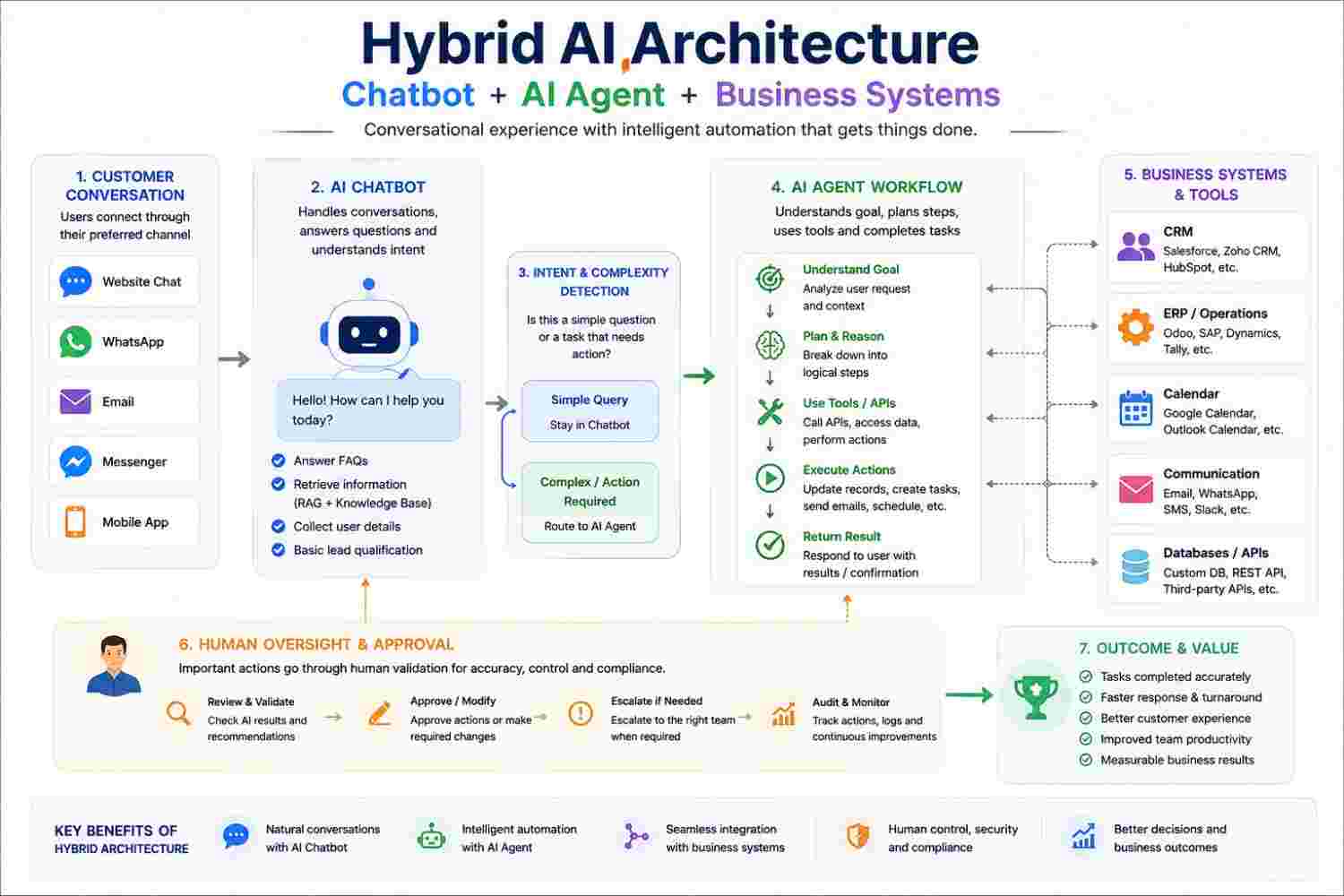
Can an AI Chatbot and AI Agent Work Together?
Yes. In many business applications, Hybrid AI architecture makes more sense than choosing one technology exclusively. The chatbot can remain the user-facing conversational layer, while an AI agent or agentic workflow performs complex tasks behind the scenes.
For example, a customer may first ask a simple product question. The chatbot answers using approved business knowledge. If the customer then requests a return, the system can collect the necessary information and invoke a controlled workflow that checks eligibility, retrieves the relevant order and starts the return process.
This approach lets businesses keep simple interactions lightweight while applying more advanced automation only where it creates measurable value.
AI Chatbot, AI Agent or Traditional Automation?
AI is not automatically the best solution for every workflow. A useful implementation decision is to compare AI with conventional automation as well as comparing chatbots with agents.
If a task is completely deterministic, for example, sending a scheduled report every Monday, a normal automation workflow may be simpler and more predictable. If the system needs to interpret natural-language input, work with unstructured information or adapt to different requests, AI can add value.
The best enterprise architecture often combines the two. AI handles interpretation and flexible decision-making, while deterministic software handles calculations, permissions and predictable business rules.
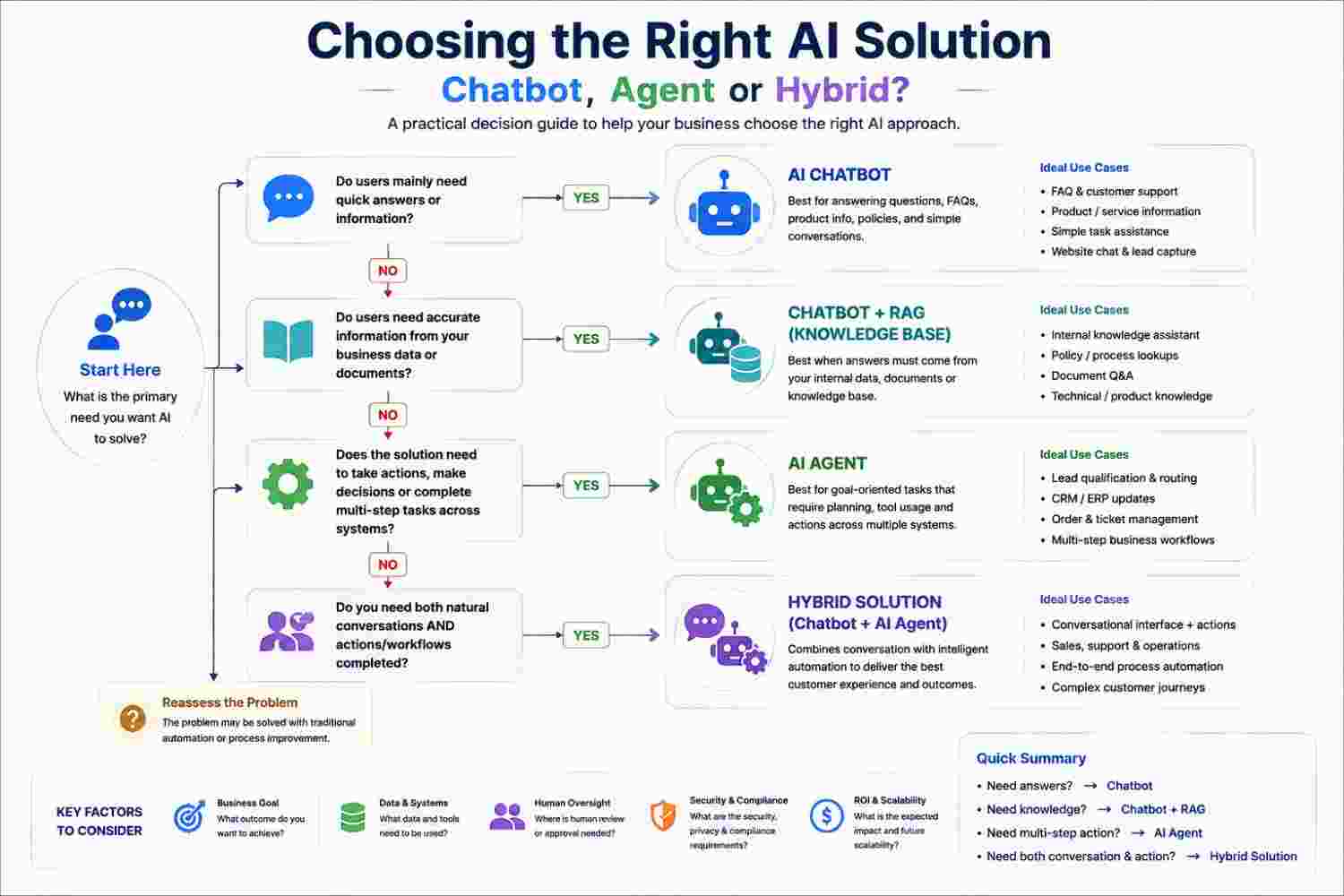
A Practical Decision Framework
Start with the outcome you want to achieve. If the requirement is mainly to answer questions or guide users, begin with an AI chatbot. If the requirement is to complete a multi-step workflow across systems, evaluate an AI agent. If both requirements exist, consider a hybrid architecture.
Next, consider the level of risk. A system that drafts an email is different from one that approves a refund or modifies financial records. The more consequential the action, the stronger the validation and human-approval controls should be.
- Conversation and information → AI chatbot
- Knowledge search → AI chatbot + RAG
- Lead capture → AI chatbot
- Complex lead qualification → AI agent
- Multi-step CRM workflow → AI agent
- Conversation plus business actions → Hybrid AI architecture
Why More Autonomous AI Is Not Always Better
There is a tendency to assume that an AI agent is automatically better because it can perform more actions. In practice, more autonomy also means more engineering responsibility. The system needs stronger permissions, validation, observability, error handling and security controls.
If a business only needs to answer frequently asked questions, an autonomous agent may create unnecessary complexity. A focused chatbot can be easier to maintain and govern while still delivering the desired result.
The right question is therefore not, “How autonomous can we make the AI?” It is, “What level of intelligence and automation is required to achieve the business outcome safely?”
What About AI Agents, RAG and Business Data?
AI agents often need access to business-specific information that a general AI model does not inherently know. Retrieval-Augmented Generation or RAG, can provide relevant information from approved company documents, knowledge bases or other data sources.
For example, an agency could connect an AI assistant to approved service documentation, case studies and process information. The system can retrieve relevant context before generating an answer. If the workflow also requires an action, the agent can use approved tools to interact with the CRM or another business application.
RAG and agents solve different parts of the problem. RAG provides contextual knowledge; agentic workflows provide controlled task execution.
AI Agent Security: What Businesses Should Consider
The moment an AI system can access business tools, security becomes a core architecture concern. An agent should not receive unrestricted access simply because an integration is technically possible.
A production system should use appropriate authentication and permissions, validate inputs, log important actions and define clear boundaries around tool usage. Sensitive or irreversible actions may require explicit human approval.
Businesses should also consider failure scenarios. What happens if an API is unavailable? What if the retrieved information is incomplete? What if the user requests something outside the agent’s permissions? A reliable AI system needs defined fallback behaviour.
How Much Does an AI Agent or Chatbot Cost?
There is no universal cost because the implementation depends on the problem being solved. A basic AI chatbot using a limited knowledge base is generally simpler than an AI agent that connects to CRM, ERP, calendars and other systems.
For AI agent development, cost can be influenced by workflow complexity, integrations, data preparation, RAG requirements, authentication, security, testing, monitoring and hosting. Ongoing AI-model usage can also affect operating costs.
For this reason, businesses should evaluate AI projects based on expected business value rather than comparing development prices alone.
How a Business Should Start
The safest approach is usually to begin with one well-defined workflow rather than attempting to automate an entire department. Identify a process that is repetitive, measurable and suitable for controlled AI assistance.
For a digital agency, this could be website lead qualification. Start with an AI chatbot that understands the agency’s approved services and captures enquiries. Once that workflow is reliable, add CRM integration and structured qualification. Later, selected agentic actions can be introduced where they provide measurable operational value.
This phased approach allows the business to learn from real usage while controlling complexity and risk.
AI Agents vs AI Chatbots: Final Recommendation
There is no universal winner in the AI agents vs AIchatbots debate. The correct choice depends on the business problem, the complexity of the workflow, the systems involved and the level of automation required.
An AI chatbot is often the right choice for customer conversations, FAQs, knowledge access and straightforward lead capture. An AI agent is more suitable when the system must work toward a goal, use multiple tools and complete a multi-step process. A hybrid architecture can combine the strengths of both.
For businesses evaluating AI development, the strongest starting point is not to ask which technology is most advanced. Start with the workflow, define the outcome, identify where AI adds value and then design the architecture around that requirement.
Conclusion
AI is becoming more useful when it moves from simply generating answers to helping businesses complete meaningful work. But that does not mean every business needs an autonomous AI agent.
The right solution is the one that solves the right problem with an appropriate level of intelligence, integration and control. For some businesses, that will be an AI chatbot. For others, it will be an AI agent. For many real-world workflows, the best answer will be a combination of conversational AI, RAG, conventional automation and controlled agentic capabilities.
If your business is evaluating an AI solution, begin by identifying one process where faster responses, better qualification or reduced manual work can be measured. From there, the architecture can grow around proven business value.
Frequently Asked Questions
Q. What is the difference between an AI agent and a chatbot?
An AI chatbot is primarily designed for conversation, information access and guided assistance. An AI agent is designed to achieve a goal by coordinating tasks, using approved tools and interacting with business systems. The boundary is not absolute because advanced chatbots can also perform actions.
Q. Is an AI agent better than an AI chatbot?
Not necessarily. A chatbot can be the better choice for FAQs, knowledge access and straightforward customer assistance. An AI agent is more appropriate for complex, multi-step workflows. The best choice depends on the business requirement.
Q. Can an AI chatbot perform actions?
Yes. Modern AI chatbots can connect to APIs, CRM systems and other tools. The practical difference is usually the breadth and complexity of the workflow the system is responsible for completing.
Q. Can an AI agent integrate with a CRM?
Yes. AI agents can be integrated with CRM platforms through APIs and other integration mechanisms. Depending on the implementation, they can retrieve information, create or update records, create tasks and support workflow automation.
Q. Should a business build an AI chatbot or AI agent first?
Start with the simplest architecture that can solve the business problem reliably. If the requirement is mainly conversation and information, a chatbot is a sensible starting point. If the core requirement is multi-step task execution, evaluate an AI agent.
Q. Can AI agents and chatbots work together?
Yes. A chatbot can provide the conversational interface while an agentic workflow handles complex actions behind the scenes. This hybrid model is useful when a business needs both customer conversation and process automation.
Q. Does every AI agent need RAG?
No. RAG is useful when an AI system needs access to business-specific documents or knowledge. An agent that does not require document retrieval may not need RAG.
Q. How much does AI agent development cost?
Cost depends on workflow complexity, integrations, data requirements, security, testing, hosting, monitoring and the level of autonomy required. A focused workflow generally requires less engineering than a multi-system enterprise implementation.