

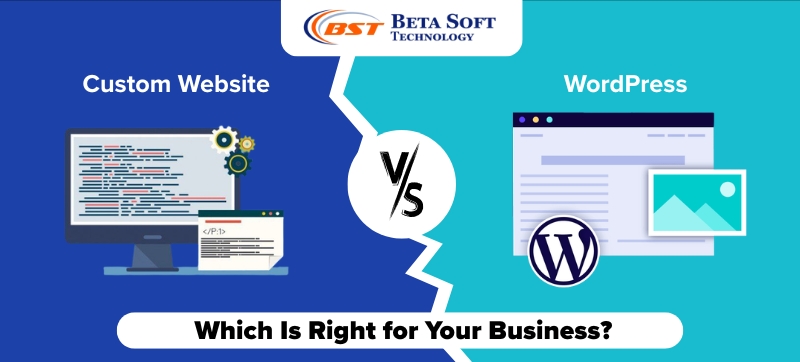
Choosing the right platform for your website is not a small decision. It shapes your brand image. It defines performance. It even influences how well you rank on Google. Many businesses face the same question:
WordPress Development vs Custom Website – which is better?
Should you build your website using WordPress, the world’s most popular CMS, or invest in a fully custom-coded solution designed from scratch?
The answer depends on your goals, budget, performance expectations, and future growth plans. This guide breaks down the real differences between WordPress vs Custom Website development, so you can make the right decision confidently.
If you are planning to hire a WordPress development company or considering a bespoke build, this article will help you decide with clarity.
Understanding the Core Difference
Before comparing cost, speed or SEO, let’s simplify the basics.
| Feature | WordPress Development | Custom Website Development |
| Platform | Built on WordPress CMS | Built from scratch with code |
| Setup | Uses themes & plugins | Fully tailored architecture |
| Launch Speed | Faster | Slower development cycle |
| Cost | Lower upfront cost | Higher initial investment |
| Flexibility | Structured customization | Unlimited scalability |
In short:
- WordPress development uses a content management system (CMS).
- A custom website uses hand-written code and frameworks.
Now, let us analyse them deeply.
What is WordPress Development?
WordPress powers over 43% of all websites globally. That is not by accident.
It offers:
- Pre-built themes
- Thousands of plugins
- SEO-friendly architecture
- Easy content management
- Lower development cost
A professional WordPress development company can customize themes, build plugins, integrate APIs, and optimize speed. So, WordPress is not just for blogs anymore. It supports enterprise-level platforms, ecommerce stores, and SaaS portals.
However, WordPress still operates within a framework. That framework creates structure. Sometimes that structure limits flexibility.
What is a Custom Website?
A custom website is developed using technologies like:
- HTML5, CSS3
- JavaScript frameworks (React, Vue, Angular)
- Backend systems (Node.js, Laravel, .NET)
- Headless CMS architecture
Here, developers write code from scratch. Everything is tailored. Nothing is pre-built unless intentionally chosen.
This means:
- Total design freedom
- Full performance optimisation
- Scalable architecture
- Advanced security control
But it also means higher costs and longer timelines.
WordPress vs Custom Website: Key Business Comparison Areas
Let us evaluate real business factors.
1. Cost Comparison
Cost is often the first filter.
| Factor | WordPress Development | Custom Website |
| Initial Cost | Low to Medium | Medium to High |
| Maintenance | Plugin & theme updates | Developer-led updates |
| Hosting | Standard hosting | Advanced hosting often needed |
| Long-Term Cost | Can increase with plugin dependency | Predictable but higher |
A basic WordPress site may cost 60–70% less than a fully custom-coded platform. However, overusing plugins can increase technical debt. That hidden cost matters. If the budget is limited, WordPress vs Custom Website often leans towards WordPress.
2. Development Time
Time-to-market impacts revenue.
- WordPress site: 2–6 weeks
- Custom website: 8–16 weeks (or more)
If speed matters, WordPress wins.
If complexity matters, custom code wins.
There is no middle ground here.
3. Performance and Speed
Page speed affects SEO rankings and conversions. Google data shows that a 1-second delay can reduce conversions by up to 7%.
Now compare.
WordPress Performance
- Depends on hosting quality
- Affected by plugin load
- Needs caching optimisation
- Can be fast if well-developed
Custom Code Performance
- Clean, minimal code
- No unnecessary scripts
- Designed for performance
- Better control over Core Web Vitals
In the debate of WordPress vs Custom code, performance typically favours custom builds, but only if developers optimise properly.
Poorly written custom code can be worse than WordPress.
4. Scalability
Planning long term? Then scalability matters.
| Feature | WordPress | Custom Website |
| Traffic Handling | Good with optimisation | Excellent |
| Complex Workflows | Plugin-based | Fully custom |
| Enterprise Integration | Possible | Seamless |
| Microservices | Limited | Strong support |
If your business expects:
- Heavy traffic
- Custom dashboards
- Complex integrations
- SaaS functionality
Then WordPress vs Custom code often tilts towards custom.
However, enterprise WordPress solutions also exist. Large brands use WordPress successfully with expert engineering.
5. Security
Security concerns are real. WordPress is popular. That makes it a target.
Most vulnerabilities come from:
- Outdated plugins
- Poor hosting
- Weak admin credentials
A reputable WordPress development company reduces these risks through:
- Secure coding
- Limited plugin use
- Regular updates
- Firewall configuration
Custom websites reduce exposure to mass attacks, but security depends entirely on development quality.
Security is never automatic.
6. SEO Capability
This is critical.
WordPress is SEO-friendly out of the box:
- Clean permalink structure
- Easy meta optimisation
- Schema plugins
- XML sitemaps
Custom websites require manual SEO structuring. If done correctly, they can outperform WordPress. But mistakes in custom builds often damage crawlability.
In most cases, businesses comparing WordPress Development vs Custom Website for SEO find WordPress easier to manage.
When to Choose WordPress VS When to Go Custom
Let us simplify with examples.
Choose WordPress if:
- You need a marketing website
- You want quick deployment
- You require easy content updates
- Budget is moderate
- SEO and blogging are priorities
Choose Custom Website if:
- You are building a SaaS product
- You need unique backend workflows
- You expect high scalability
- You require complete design control
- Security requirements are strict
How to Choose a Reliable WordPress Development Company
When selecting a development partner, look for:
- Proven portfolio
- Transparent process
- Strong UI/UX capability
- Technical certifications
- Client testimonials
- Ongoing support model
An experienced WordPress development company ensures:
- Clean code structure
- Custom plugin development
- Speed optimisation
- Security hardening
- API integration
The difference is not the platform. It is execution.
WordPress vs Custom Website: Quick Comparison Chart
| Criteria | WordPress | Custom Website |
| Ease of Use | Excellent | Moderate |
| Development Cost | Lower | Higher |
| Flexibility | Good | Unlimited |
| Performance Control | Medium | High |
| Maintenance | Easier | Developer Required |
| SEO Management | Easier | Advanced setup needed |
| Time to Launch | Fast | Slower |
Technical Breakdown: WordPress vs Custom Code Architecture
| Technical Element | WordPress | Custom Code |
| CMS | Built-in | Optional |
| Database | MySQL | Flexible |
| Backend | PHP | Any language |
| Frontend | Theme-based | Fully custom |
| API Integration | Plugin-supported | Native integration |
This comparison clarifies the debate around WordPress vs Custom code from a technical perspective.
Final Verdict: WordPress Development vs Custom Website
The debate around WordPress Development vs Custom Website is not about superiority. It is about suitability.
Technology should serve strategy. Not the other way around.
Businesses that evaluate:
- Budget
- Growth plans
- Technical needs
- SEO objectives
- Long-term scalability
When comparing WordPress vs Custom Website, focus on your roadmap. Not trends.
And when considering WordPress development, always choose a skilled WordPress development company that understands architecture, performance, and security, not just themes and plugins.
Because in the end, execution defines success.
Frequently Asked Questions
1. Is WordPress only suitable for small businesses?
No. WordPress is widely used by both small businesses and large enterprises. Many high-traffic brands use WordPress with custom themes, advanced hosting setups, and tailored plugin development.
2. Does a custom website automatically mean better performance?
Not necessarily. A custom website can deliver better performance because developers control every line of code. There are no unnecessary plugins or pre-built scripts.
But performance depends on how well the site is engineered. Poorly written custom code can be slower than an optimised WordPress website. The real factor is development quality, not just the platform.
3. Is WordPress cheaper in the long term?
In most cases, yes. WordPress usually requires lower upfront investment and easier maintenance. Updates, content changes, and SEO adjustments are simpler to manage.
4. Can WordPress handle ecommerce effectively?
Yes. WordPress can power ecommerce websites using tools like WooCommerce, which supports product management, payment gateways, shipping integrations, and inventory tracking. For small to mid-sized ecommerce stores, WordPress works very well.
5. Which platform is better for SEO: WordPress or custom websites?
WordPress is generally easier for ongoing SEO management because it supports clean site structures, blogging, and SEO plugins. Custom websites, however, can outperform WordPress when technical SEO is engineered correctly from the ground up – including Core Web Vitals, schema implementation and crawl optimization.