


Every Salesforce Shopify integration project starts with a different business objective.
Some organizations want to create a single view of their customers. Others need better sales reporting, improved order visibility, or automated workflows between Shopify and Salesforce. For some, the priority is replacing manual processes, while others are preparing their business for future growth.
Although every project has unique requirements, we’ve noticed something interesting after working with businesses across multiple industries, including healthcare, education, B2B manufacturing, dental instruments and equipment, home décor, fashion, cosmetics and consumer retail.
The industries are different.
The products are different.
The customer journeys, sales cycles and operational processes are different.
Yet many of the same implementation patterns appear repeatedly.
Businesses that invest time in understanding their processes before implementation often achieve smoother deployments and better long-term results. On the other hand, organizations that focus only on connecting Salesforce and Shopify without considering how their teams actually work usually face avoidable challenges after go-live.
These observations haven’t come from a single project or a single industry. They’ve emerged over time by working with businesses that had different goals but shared a common objective, using Salesforce and Shopify together to improve business efficiency and customer experience.
This article isn’t a technical implementation guide or a checklist of platform features.
Instead, it’s a collection of practical insights we’ve gained while supporting Salesforce Shopify integration projects across different industries. Whether you’re planning your first integration or looking to improve an existing one, these lessons can help you make better business decisions before, during, and after implementation.
What Are the Most Important Lessons for a Successful Salesforce Shopify Integration?
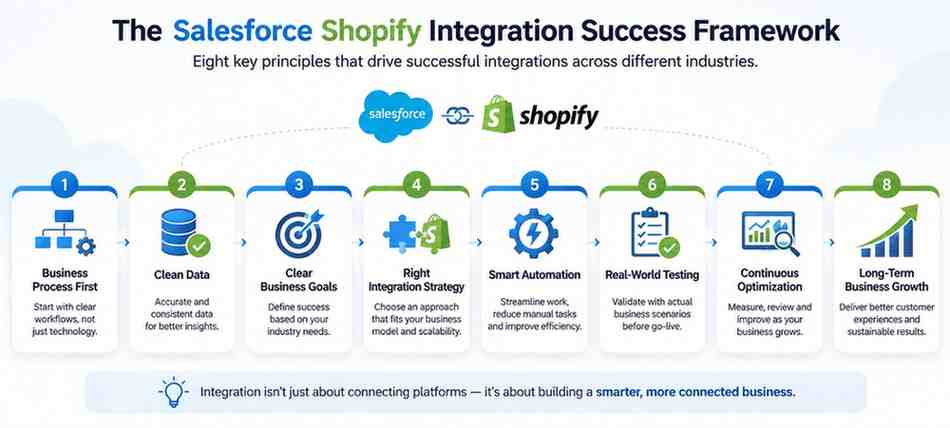
Every Salesforce Shopify integration is unique, but the most successful projects share common characteristics. Businesses that prioritize process planning, data quality, stakeholder alignment, and continuous improvement consistently achieve better outcomes than those focusing only on technical implementation. The insights in this guide are based on practical observations from projects delivered across multiple industries.
What We’ve Learned #1: Business Processes Always Come Before Technology
One of the biggest lessons we’ve learned is that successful Salesforce Shopify integrations start with understanding the business, not the technology.
Many organizations begin by discussing APIs, integration tools or timelines. While these decisions matter, they should come after understanding how sales, marketing, customer support and operations actually work together.
We’ve seen this across healthcare, education, B2B, home décor, fashion, and consumer brands. Every industry has different workflows, customer journeys and reporting needs, which means no two integrations should be identical.
Our Perspective
The best integrations don’t force businesses to change their processes. Instead, they use Salesforce and Shopify to support the way the business already operates while creating room for future growth.
What We’ve Learned #2: Clean Data Delivers Better Business Outcomes
A Salesforce Shopify integration can only be as effective as the data it connects.
Across multiple projects, we’ve found that duplicate customer records, inconsistent product information and outdated data create more post-launch challenges than the integration itself. Clean data improves reporting, automation, customer experience, and decision-making across every department.
Businesses that invest time preparing their data before implementation usually experience smoother deployments and faster user adoption.
Our Perspective
Integration doesn’t automatically fix data quality—it simply makes existing data more visible. Treating data preparation as a business priority rather than a technical task creates a stronger foundation for long-term success.
What We’ve Learned #3: Every Industry Defines Success Differently
One of the biggest misconceptions about Salesforce Shopify integration is that every business measures success in the same way.
Our experience tells a different story.
While the technology remains the same, business goals vary significantly across industries. A fashion brand may focus on customer retention and personalized marketing, while a B2B business values opportunity tracking and account management. An education provider often prioritizes enquiry management, whereas a home décor retailer may focus on inventory visibility and order fulfilment.
This is why successful integrations begin by defining business outcomes before configuring the technology.
Our Perspective
The most effective Salesforce integrations aren’t built around platform features—they’re built around business objectives. When success is clearly defined from the beginning, every workflow, automation, and report becomes easier to design.
Related Reading: Learn how the right implementation approach makes a difference in our How to Choose the Right Salesforce Shopify Integration Partner guide.
What We’ve Learned #4: One Integration Doesn’t Fit Every Business
It’s tempting to copy an integration approach from another company, especially within the same industry.
However, we’ve found that businesses with similar products often have completely different internal processes, approval workflows, sales structures, and customer journeys.
A solution that works perfectly for one organization may create unnecessary complexity for another.
That’s why understanding the business always comes before selecting the technical solution.
Our Perspective
Templates can accelerate development, but every successful integration still requires discovery, planning, and customization based on how the business actually operates.
Related Reading: Planning your project? Our Salesforce Shopify Integration Cost guide explains how business complexity influences implementation effort and pricing.
Industry Insights: What We’ve Learned Across Different Salesforce Projects
| Industry | Common Business Challenge | What We’ve Learned | Primary Focus During Integration |
| Healthcare | Customer information is often managed across multiple systems, making consistency and reporting difficult. | Accurate data and well-defined workflows are more valuable than excessive automation. | Data accuracy, process consistency, reporting, and secure information flow. |
| Education | Student enquiries, admissions, and follow-ups involve multiple teams and touchpoints. | Lead management should reflect the complete student journey rather than isolated enquiries. | Lead nurturing, workflow automation, counsellor visibility, and lifecycle tracking. |
| B2B Manufacturing | Longer sales cycles, multiple stakeholders, and account-based selling increase CRM complexity. | Salesforce should support relationship management, not just order synchronization. | Account management, opportunity tracking, quotations, and sales forecasting. |
| Dental Instruments & Equipment | Managing dealers, distributors, and repeat institutional buyers requires structured account data. | Organizing business accounts is just as important as managing individual customer records. | Dealer management, customer hierarchy, product visibility, and account reporting. |
| Fashion & Apparel | Rapid order volumes, seasonal promotions, and repeat customers create dynamic customer journeys. | Customer experience depends on timely data synchronization and personalized engagement. | Customer segmentation, loyalty programs, marketing automation, and order visibility. |
| Cosmetics & Beauty | Customer retention is driven by repeat purchases and personalized marketing campaigns. | Clean customer data enables more effective automation and long-term customer engagement. | Customer profiles, purchase history, audience segmentation, and campaign optimization. |
| Home Décor | Larger product catalogs and inventory planning often require coordination between multiple business functions. | Sales, inventory, and customer data should remain connected to improve operational visibility. | Inventory synchronization, order management, reporting, and customer insights. |
What We’ve Learned #5: Automation Should Simplify Work—Not Add Complexity
Automation is one of Salesforce’s greatest strengths, but more automation doesn’t always mean better results.
We’ve seen businesses automate processes that change frequently, resulting in additional maintenance and unnecessary complexity.
The best automations eliminate repetitive manual work while remaining easy to understand and maintain as the business evolves.
Our Perspective
Before creating a new workflow, ask a simple question:
Will this save time for the business six months from now—not just today?
If the answer is yes, it’s usually worth automating.
What We’ve Learned #6: Test Real Business Scenarios, Not Just System Connections
Many implementation teams verify that data synchronizes correctly between Shopify and Salesforce.
That’s important—but it’s only part of the testing process.
Successful businesses also test real operational scenarios.
For example:
- What happens when an order is cancelled?
- How are refunds handled?
- What if a customer places multiple orders?
- Does every department see the information they actually need?
These practical scenarios often reveal improvements that technical testing alone cannot identify.
Our Perspective
A technically successful integration isn’t enough. The real goal is ensuring the integration supports everyday business operations with confidence.
What We’ve Learned #7: Go-Live Is Only the Beginning
Launching an integration is a major milestone, but businesses rarely remain unchanged after implementation.
New products, evolving customer expectations, additional sales channels, and changing internal processes all create new requirements over time.
The businesses that achieve the greatest long-term value continue reviewing and improving their Salesforce environment instead of treating the project as complete.
Our Perspective
The most successful Salesforce Shopify integrations aren’t static—they continue evolving alongside the business.
Related Reading: See how businesses maintain long-term performance in our Managed Salesforce Shopify Integration Support vs One-Time Fixes guide.
What We’ve Learned #8: Technology Supports Growth, but Strategy Drives Success
Looking back across projects in healthcare, education, B2B, fashion, cosmetics, home décor, dental equipment, and other industries, one conclusion stands out.
The success of a Salesforce Shopify integration is rarely determined by the integration platform itself.
It’s influenced by business planning, data quality, stakeholder alignment, thoughtful automation, and a commitment to continuous improvement.
Technology enables those outcomes, but strategy makes them possible.
Our Perspective
Every project has unique challenges, yet the organizations that achieve the best results all share one characteristic:
They view Salesforce Shopify integration as a long-term business investment rather than a one-time technical project.
Key Takeaways
Every Salesforce Shopify integration project is unique, but the lessons we’ve learned remain remarkably consistent.
- Start with business processes, not technology.
- Invest in clean and reliable data before integration.
- Define success based on your industry’s objectives.
- Avoid one-size-fits-all implementation approaches.
- Build automation that supports long-term operations.
- Test real business scenarios—not just system connectivity.
- Continue optimizing after go-live.
- Treat integration as an ongoing business strategy, not a one-time project.
Following these principles can help businesses reduce implementation risks, improve user adoption and maximize the long-term value of both Salesforce and Shopify.
Final Thoughts
Every Salesforce Shopify integration project teaches something new.
Although industries, products, and customer journeys vary, we’ve found that the same core principles consistently lead to successful implementations: understanding business processes, maintaining clean data, planning for scalability and continuously improving after go-live.
Technology alone doesn’t create business value. The greatest results come from aligning Salesforce with the way your teams work and the goals your business wants to achieve.
Whether you’re preparing for your first integration or optimizing an existing Salesforce environment, taking a strategic, business-first approach will help you build a solution that supports growth today and remains adaptable for the future.
Ready to Plan Your Salesforce Shopify Integration?
Every business has unique processes, challenges and growth objectives. That’s why there’s no one-size-fits-all approach to Salesforce Shopify integration.
At Beta Soft Technology, we help businesses design integration strategies that align with their workflows, improve operational efficiency, and support long-term growth. From implementation planning and data migration to optimization and ongoing support, our team works closely with you to build solutions that deliver measurable business value.
Have questions about your Salesforce integration strategy? Get in touch with our team to discuss your business goals and explore the best approach for your organization.
Frequently Asked Questions About Salesforce Shopify Integration
Q 1. What is the biggest challenge in a Salesforce Shopify integration?
The biggest challenge is rarely the technology itself. Most implementation issues arise from unclear business processes, inconsistent data, or undefined project goals before development begins.
Q 2. Can the same integration approach work for every business?
No. Every business has different workflows, customer journeys, reporting needs, and operational objectives. A successful integration should be tailored to your business requirements rather than copied from another organization.
Q 3. Why is data quality important before integration?
Salesforce and Shopify can only exchange the data they receive. Clean, accurate, and well-structured data improves reporting, automation, and customer management while reducing post-implementation issues.
Q 4. How long does a Salesforce Shopify integration project typically take?
The timeline depends on the complexity of your business, the number of workflows involved, data preparation requirements, and any custom development needed. Smaller projects may take a few weeks, while larger implementations require additional planning and testing.
Q 5. Should we customize Salesforce or use standard features?
Standard Salesforce features should always be considered first. Customization is recommended only when it supports a genuine business requirement and provides long-term value.
Q 6. Is testing really that important before go-live?
Absolutely. Testing real business scenarios—such as returns, refunds, order updates, and customer lifecycle changes—helps identify issues before they impact daily operations.
Q 7. Does a Salesforce Shopify integration require ongoing support?
Not every business requires managed support. However, organizations that regularly introduce new products, workflows, or connected systems often benefit from periodic reviews and continuous optimization.
Q 8. When should we work with a Salesforce Shopify Integration Consultant?
A consultant is valuable during planning, implementation, or when improving an existing integration. Early guidance can help avoid costly mistakes and ensure the solution aligns with your long-term business goals.